
Is Claude Better Than ChatGPT? Why People Are Switching to Claude in 2026
Artificial intelligence is changing how people write, research, design, code, and manage everyday work. While ChatGPT remains a widely recognized AI assistant, Claude, developed by Anthropic, has gained attention for its writing style, coding capabilities, and approach to complex tasks.
This has led to several common questions: Is Claude better than ChatGPT? Why is Claude so famous? Why are people leaving ChatGPT for Claude? And why does Claude sometimes seem meaner than ChatGPT?
The answer depends on what you expect from an AI assistant. Both tools offer powerful capabilities, but their features, responses, and strengths can differ depending on the task.
In this guide, we compare Claude and ChatGPT, explore why Claude is attracting attention, and explain how to choose the right AI tool for your needs.
What Is Claude AI?
Claude is an AI assistant developed by Anthropic, an artificial intelligence company focused on building helpful, reliable, and safety-conscious AI systems.
Like ChatGPT, Claude can answer questions, summarize documents, write content, analyze information, assist with programming, and help users solve problems.
Claude is also used for software development and complex workflows. Anthropic’s official Claude Code announcement explains how its coding tool can work with codebases, edit files, run tests, and support development tasks.
ChatGPT, developed by OpenAI, offers a broad range of capabilities, including writing, web research, image generation, file analysis, and coding assistance. Its available features depend on the model, plan, and tools being used. You can explore the official ChatGPT capabilities overview for more details.
Is Claude Better Than ChatGPT?
Neither Claude nor ChatGPT is universally better. The right choice depends on your workflow, preferred response style, and the features you need.
Claude is often considered for long-form writing, document-heavy work, and coding tasks. ChatGPT is a versatile option for users who want a range of creative, research, and productivity tools in one place.
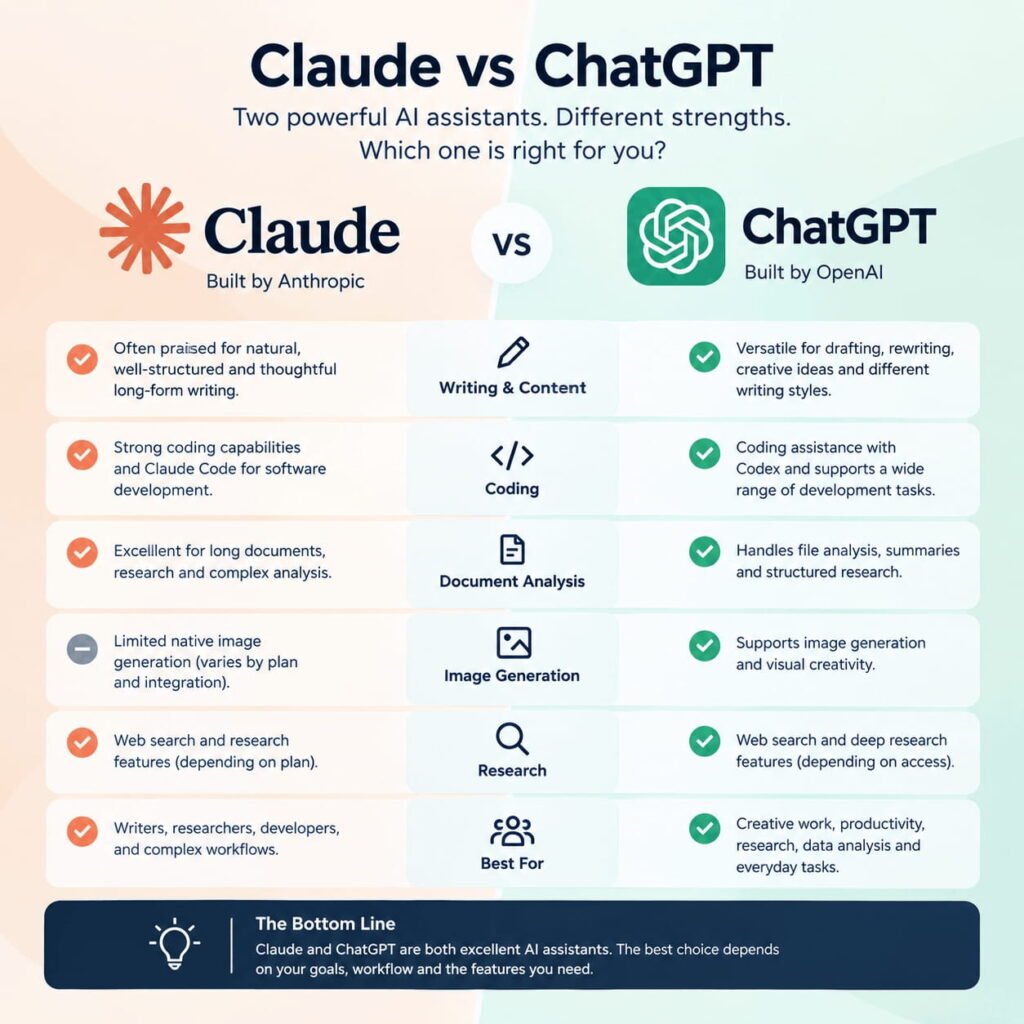
Here is a practical comparison.
| Feature | Claude AI | ChatGPT |
|---|---|---|
| Writing and editing | Often appreciated for natural-sounding prose | Versatile for drafting, rewriting, and generating variations |
| Coding | Coding assistance and Claude Code | Coding assistance and Codex |
| Long documents | Useful for document-heavy workflows | Useful for document analysis and summarization |
| Image generation | Check current native features and integrations | Supports image generation |
| Research | Web search and research features, depending on plan | Web search and deep research features, depending on access |
| Creative work | Writing, analysis, and creative workflows | Writing, image creation, brainstorming, and analysis |
| Best use | Workflows that benefit from detailed analysis and writing | Broad everyday and professional assistance |
These are general comparisons, not guaranteed performance rankings. Results vary by model, prompt, and task.
For official product details, see Claude’s features and plans and ChatGPT’s capabilities.
When Should You Choose Claude?
Claude may be a good choice if you frequently:
- Write or edit long articles, reports, and professional documents.
- Analyze lengthy files or complicated information.
- Develop software or work with existing codebases.
- Refine writing to achieve a particular tone.
- Work through complex problems that require multiple rounds of discussion.
For example, a content strategist might use Claude to review a lengthy brand strategy document, identify inconsistencies, and improve messaging across multiple sections.
When Should You Choose ChatGPT?
ChatGPT may be a better fit if you want one assistant for a wide variety of tasks, such as:
- Generating and editing text.
- Creating images for marketing and creative projects.
- Researching topics and organizing information.
- Analyzing spreadsheets and other data.
- Exploring ideas, planning projects, and solving everyday problems.
For example, an e-commerce business owner could use ChatGPT to brainstorm campaign ideas, develop visual concepts, analyze sales data, and create marketing content.
If you’re exploring the role of AI in online visibility, read our guide to ChatGPT Search SEO, which explains how businesses can prepare their websites for AI-powered search experiences.
The practical takeaway: Instead of choosing an AI tool because it is trending, compare how well it performs on the tasks you actually do.
Why Is Claude So Famous?
Claude’s growing popularity comes from several factors rather than one single breakthrough.
1. Natural-Sounding Writing
One reason people appreciate Claude is its writing style. Many users find its responses conversational, well-structured, and suitable for long-form content.
It can help with blog posts, business documents, product descriptions, email drafts, and creative writing.
However, writing quality is subjective. ChatGPT can also produce excellent writing when given clear instructions and relevant context.
2. Strong Coding Capabilities
Claude has attracted attention from developers through its coding capabilities and Claude Code, which supports working with software projects.
Developers can use coding assistants to understand existing code, investigate bugs, implement features, and improve software. The effectiveness of these workflows depends on the task, model, and development environment.
You can learn more about Claude Code in Anthropic’s official announcement.
3. Working With Long Documents
Claude is also used for tasks involving substantial documents, research material, and complex instructions.
This can be useful when reviewing reports, analyzing research, examining product documentation, or working with multiple related files.
The amount of information an AI model can process at once varies by model and plan. A larger context window does not automatically guarantee more accurate answers.
For current details, consult the official Claude plans and features page.
4. A Different Conversational Experience
Some users prefer Claude’s response style because it can feel thoughtful, measured, and less formulaic in certain conversations.
For writers, researchers, consultants, and other professionals, the way an AI communicates can matter almost as much as its technical capabilities.
Still, the experience varies by model version, instructions, and individual preferences.
5. Growing Interest in AI-Powered Workflows
AI assistants are increasingly being used for more than answering questions. They can support multi-step tasks, assist with software development, analyze documents, and help organize professional workflows.
Claude’s tools and integrations have helped it gain attention in these areas.
Its popularity reflects a broader shift in AI adoption: people increasingly evaluate assistants based on how effectively they help complete real work.
Why Are People Leaving ChatGPT and Going to Claude?
The question assumes that users are abandoning ChatGPT in large numbers. A more accurate explanation is that some users are switching, while others are experimenting with Claude or using both assistants.
Several factors help explain this interest.
1. They Prefer Claude’s Writing Style
Some users feel that Claude produces more natural prose with fewer generic phrases or repetitive structures.
This can be especially important for writers, marketers, content creators, and professionals who regularly produce detailed written material.
However, the quality of AI writing depends heavily on the instructions provided. Clear prompts that specify the audience, purpose, tone, and desired structure can improve results with either tool.
2. They Want Different Coding Tools
Developers may explore Claude because of its coding capabilities and Claude Code workflow.
For someone building a website, reviewing a large codebase, or making changes across several files, the experience of using a coding agent can influence which assistant they prefer.
ChatGPT also provides coding assistance through its tools, including Codex. Compare both options using the requirements of your actual project.
3. They Are Frustrated With Specific Limitations
People sometimes change AI tools because of usage limits, unsatisfactory responses, product changes, or features that do not meet their needs.
These frustrations are not unique to ChatGPT. Claude users may also encounter usage limits, incorrect answers, refusals, or features that do not fit their expectations.
Trying an alternative can be a reasonable way to find a better fit.
4. They Want More Control Over Complex Tasks
Some users prefer an assistant that works well with detailed instructions, lengthy documents, and iterative problem-solving.
Claude can be attractive for these workflows, while ChatGPT offers its own combination of reasoning, research, creative, and productivity features.
The difference is not simply about intelligence. It is also about how the tools fit into a user’s existing work.
5. Social Media Influences AI Trends
Online discussions, developer communities, product reviews, and demonstrations can quickly make an AI tool more visible.
When users see others praising a new model, they often test it themselves. This creates interest, experimentation, and sometimes a change in preference.
However, viral posts do not establish that most ChatGPT users are leaving. Platform growth, user retention, and switching behavior are different measurements.
Are people really leaving ChatGPT?
Interest in Claude does not automatically mean ChatGPT is losing its audience. Both products can attract new users at the same time, and many people use multiple AI assistants for different tasks.
The more useful question is not which platform is winning online discussions, but which tool consistently delivers better results for your needs.
Why Is Claude Meaner Than ChatGPT?
Some users describe Claude as meaner, colder, stricter, or more judgmental than ChatGPT. This is usually a perception of its response style rather than evidence that Claude has human emotions or intentions.
There are several possible explanations.
1. Claude Can Sound More Direct
Depending on the model and prompt, Claude may respond with direct criticism, cautious language, or a firm explanation of why an idea is flawed.
For example, if you ask an AI to evaluate a weak business strategy, one response might emphasize encouragement before presenting suggestions. Another might lead with the strategy’s shortcomings.
The second response can feel harsher even if the underlying advice is useful.
2. Safety Rules Can Affect Its Responses
AI assistants are designed with rules intended to reduce harmful or inappropriate outputs.
When a request triggers these safeguards, an assistant may refuse, redirect the conversation, or explain its limitations. Users can interpret these responses as judgmental or unnecessarily strict.
Claude and ChatGPT both have safety policies, and their responses can differ depending on the request and model version.
3. It May Challenge Your Assumptions
An AI assistant is not always supposed to agree with the user.
If you ask Claude to critique an idea, review an argument, or identify weaknesses in a plan, it may highlight problems you did not expect.
This can feel negative, especially when the response is direct. However, constructive disagreement can be useful when it is specific, respectful, and supported by reasoning.
The key distinction is between honest criticism and unnecessarily harsh communication.
4. Your Prompt Can Change the Tone
The way you instruct an AI can significantly influence its response.
If you want useful feedback without an unnecessarily harsh tone, try this prompt:
“Evaluate my idea honestly. Identify its weaknesses, explain your reasoning, and suggest practical improvements. Be direct but respectful, and avoid unnecessary negativity.”
You can use similar instructions with ChatGPT or Claude.
Is Claude Actually Meaner Than ChatGPT?
There is no universal rule that Claude is meaner. Its tone varies by model, prompt, conversation context, and the type of feedback requested.
If one assistant’s communication style works better for you, that preference is valid. But it is worth testing both tools with the same prompt before drawing a broad conclusion.
Can You Use Claude and ChatGPT Together?
Yes. For many professionals, using both tools can be more practical than committing to a single platform.
Each assistant can serve a different role depending on the task.
For example, a digital marketer could use Claude to review a detailed content strategy and improve long-form copy, then use ChatGPT to brainstorm campaign concepts, create visual assets, or analyze marketing data.
A developer might compare the tools when debugging a complicated issue. A business owner might use both to examine a proposal from different perspectives.
Using two AI assistants does not guarantee better results, and paid subscriptions are not necessary for everyone. Start with the free options available to you and pay only when the additional capabilities justify the cost.
What Does This Mean for Businesses and Digital Marketing?
The growth of AI assistants creates opportunities for businesses to improve productivity, content creation, research, and customer communication.
It also changes how people discover information online.
Businesses should continue investing in useful website content, strong technical SEO, clear brand messaging, and credible information about their products and services.
If your business sells online, a well-structured website is an important foundation for both traditional search visibility and a better customer experience. Our guide to e-commerce website design in Pakistan explores considerations for building an effective online store.
As AI-powered search experiences evolve, it is also worth making content easy for search engines and AI systems to understand. This includes answering real customer questions, using descriptive headings, supporting claims with reliable sources, and maintaining accurate business information.
For a deeper look at this topic, read UBINK’s guide to ChatGPT Search SEO.
However, appearing in AI-generated answers is not guaranteed by publishing a few AI-related articles. Strong content, technical accessibility, credibility, and relevance remain important.
At UBINK, we believe businesses should evaluate AI tools based on practical outcomes rather than online hype. The goal is to use technology to improve the quality of work, support smarter decisions, and create better customer experiences.
Frequently Asked Questions
Is Claude better than ChatGPT for writing?
Many users prefer Claude for long-form writing and editing, while others prefer ChatGPT for its versatility. Test both using the same brief and compare the final results.
Why is Claude AI so popular?
Claude has gained attention for its writing capabilities, coding tools, document analysis, and approach to complex professional tasks. Its popularity is also influenced by product updates, online reviews, and recommendations from other users.
Why are people switching from ChatGPT to Claude?
Some users prefer Claude’s writing style, coding workflow, or handling of complex tasks. Others are simply experimenting with alternatives. This does not mean all, or even most, ChatGPT users are switching.
Why does Claude sometimes sound rude?
Claude can sound blunt when criticizing an idea, enforcing a restriction, or explaining a problem. Its tone depends on the model and conversation. Asking for direct but respectful feedback can help.
Is Claude free to use?
Claude offers free and paid plans, although availability, usage limits, and features can vary by region and change over time. Check Anthropic’s official pricing page for current details.
Can Claude replace ChatGPT completely?
It can replace ChatGPT for some users, but not necessarily for everyone. If you rely on features that differ between the platforms, such as image generation or particular integrations, compare those capabilities before switching.
Which AI is best for business: Claude or ChatGPT?
The best choice depends on the business’s needs. Claude may suit document-heavy workflows, detailed writing, and coding tasks, while ChatGPT can support a wide range of research, creative, and productivity activities. Businesses should evaluate accuracy, privacy, cost, integrations, and measurable results before choosing.
Final Thoughts: Should You Choose Claude or ChatGPT?
Claude and ChatGPT are both capable AI assistants, and neither is the right choice for every situation.
Claude deserves consideration if you prioritize detailed writing, document analysis, and coding workflows. ChatGPT is worth considering if you want a versatile assistant that supports a broad range of tasks, including image generation and data analysis.
You do not need to follow every AI trend or switch platforms simply because others are doing so. Test the tools on your actual work, compare the results, and choose the one that helps you achieve your goals.
For businesses, the bigger opportunity is learning how to integrate AI into practical workflows without losing accuracy, originality, or human judgment.
Looking to strengthen your digital presence? UBINK helps businesses build their brand identity, websites, and digital marketing assets with a focus on clear communication and practical business goals.
Explore our design and digital services or view our portfolio.